
Licensed appraiser or AI estimate: which one you need, and when
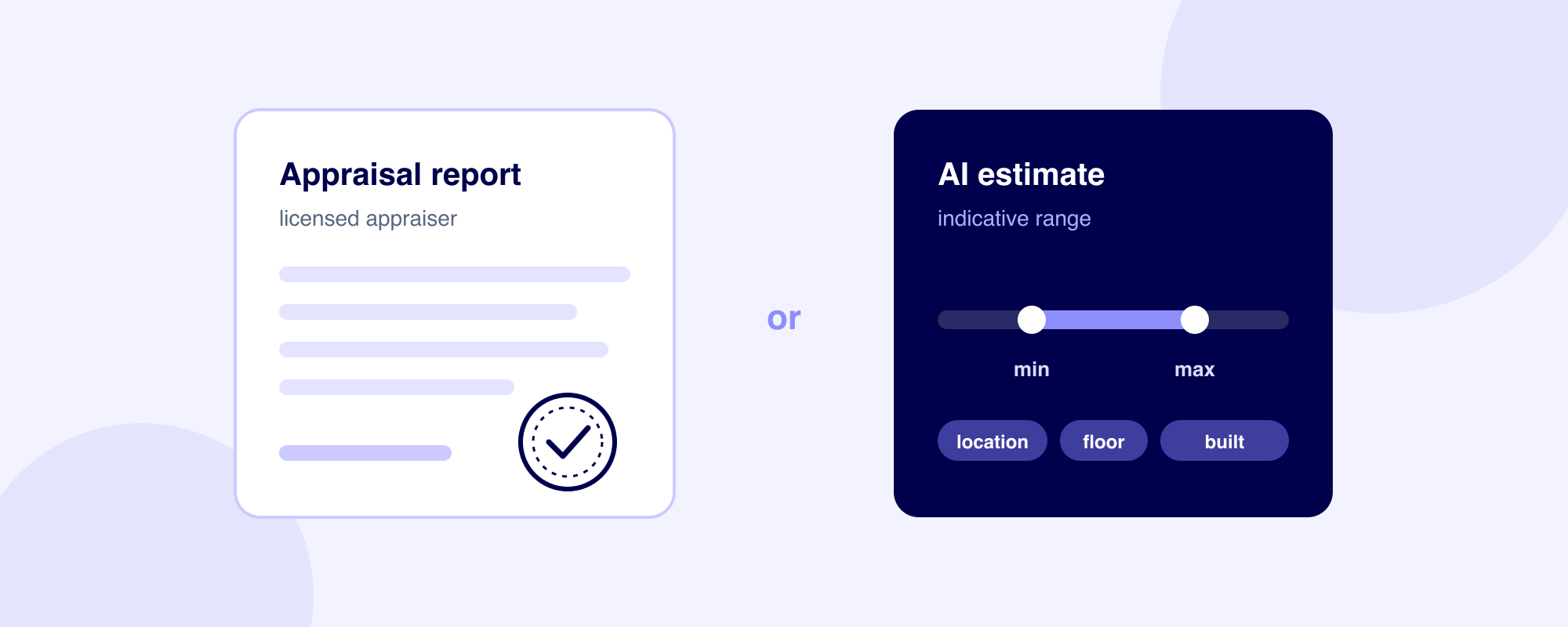
Short answer: you need a licensed appraiser when the valuation has to stand up before a bank, a court or another institution, for example for a home loan, a probate case or the division of property. An AI estimate is a fast, free orientation: useful when a seller is thinking about a price, when an agent prepares a first conversation with an owner, or when a buyer wants to check whether a listing is realistic. One does not replace the other. They do different jobs.
At a glance
| Feature | Licensed appraiser | AI estimate |
|---|---|---|
| Who does it | a permanent court expert or a permanent court appraiser | software, based on the data you enter |
| Legal value | yes, banks and courts accept the valuation report (elaborat) | no, it serves only as orientation |
| Site visit | yes, an inspection of the property and its documents | no |
| Duration | days | seconds |
| Cost | paid | mostly free or included in the tool |
| Result | an assessed market value with reasoning | an indicative price range and the main factors |
| Best for | loans, courts, probate, division of property, official purposes | a first estimate, negotiations, checking a listing |
Pros and cons: licensed appraiser and AI estimate
| Feature | Pros | Cons |
|---|---|---|
| Licensed appraiser | Legal value. The valuation report (elaborat) carries legal weight and is used for loans, probate, division of property and other official purposes. For a loan, the bank usually decides itself which appraisers it accepts. Site visit. The appraiser inspects the property and its documents. Sees what a description does not show. The real condition of the property, the quality of the construction, the ownership status in the land register, legalization and encumbrances. Accountability for the result. The assessed market value is reasoned in a valuation report that the appraiser signs and is accountable for. | Time. A valuation takes days. Cost. A valuation is paid for. Not meant for a quick orientation. When an owner is only thinking about selling or a buyer is checking a listing price, an AI estimate gives a faster answer. |
| AI estimate | Speed. You get an indicative price range within seconds. Cost. It is mostly free or included in a tool the agency already uses. Explained factors. Along with the range, it states which factors determine it most, so the conversation with the owner is about concrete factors rather than a feeling. A good starting point. It is useful for a first estimate, for preparing negotiations and for checking whether a listing is realistic. | No legal value. It serves only as orientation. For a loan or for proceedings before a court or a notary public, a valuation by a licensed appraiser is required. It does not see the property. It does not see the condition inside, the legal status (land register, division into units, legalization, encumbrances) or features that do not fit into form fields. Reliability depends on the data. Accuracy depends on the tool and on how complete the data is. For unusual properties, small towns with few sales and properties with legal problems it is not reliable. |
What a licensed appraiser does
The valuation of the market value of real estate in Croatia is governed by the Zakon o procjeni vrijednosti nekretnina (the Croatian Real Estate Valuation Act, NN 78/15, where NN stands for Narodne novine, the Croatian Official Gazette). Under it, valuations are prepared by permanent court experts and permanent court appraisers for real estate valuation. This is not a formality: the law describes valuation as a multidisciplinary procedure, and the result is a valuation report (elaborat) that the appraiser signs and is accountable for.
The appraiser uses one of three methods set out in the Pravilnik o metodama procjene vrijednosti nekretnina (the Ordinance on Real Estate Valuation Methods, NN 105/15):
- The comparison method compares the property with similar properties that were actually sold. It is the most common method for apartments and houses.
- The income method calculates value from the income the property generates. It is used for commercial premises and rental properties.
- The cost method starts from the cost of construction, reduced for age. It is used when there are no comparable sales.
In addition, the appraiser looks at what no tool can see from a description: the real condition of the property, the quality of the construction, the ownership status in the land register, whether the building is legalized, and whether there are encumbrances. That is why it takes days rather than minutes, and why it is paid for.
When it is required:
- A home loan. The bank requires a valuation of the property that serves as collateral for the loan, and it usually decides itself which appraisers it accepts.
- Court proceedings. Probate, division of property, enforcement, bankruptcy.
- Other official purposes, when an institution requires a valuation that carries legal weight.
What an AI estimate does
From the property data (location, floor area, floor, number of rooms, year of construction, condition, energy class, parking, view), an AI estimate gives an indicative price range within seconds and explains which factors determine it most.
There are two kinds of such tools, and it helps to know the difference:
- Statistical models (AVM, automated valuation model) calculate from a large number of actual sales in the area. They are only as good as the freshness of the data they run on.
- Language models (such as ChatGPT) estimate from the description of the property and general knowledge of the market. They are excellent for a quick orientation and for explaining factors, but they do not know every actual sale in your neighborhood.
In both cases the same rule applies: an AI estimate is a starting point, not a final price.
What an AI estimate does not see:
- the condition inside (whether the apartment was renovated two years ago or twenty, and how well)
- the legal status (land register, division into units, legalization, encumbrances)
- features that do not fit into form fields (street noise, neighbors, layout)
- small markets with few sales, where there are too few comparable properties for a reliable conclusion
Which one to use: five typical situations
1. An owner is thinking about selling and asks “how much is my apartment worth”
AI estimate. The owner gets an indicative range right away, and if they get serious about selling, the agent guides them further through actual comparisons.
2. An agent goes to the first meeting with an owner
AI estimate, plus actual sales in the neighborhood. A range with the reasoning behind its factors is a good start to the conversation, especially when the owner has unrealistic expectations.
3. A buyer is taking out a home loan
Licensed appraiser. Without it the bank will not approve the loan, and an AI estimate carries no weight here.
4. Heirs are dividing a property
Licensed appraiser. When the value is decided before a court or a notary public, a valuation report is required.
5. A buyer checks whether the listed price is realistic
AI estimate as a quick check, and for a more serious decision, data on actual sales as well. The Ministarstvo prostornoga uređenja, graditeljstva i državne imovine (the Croatian Ministry of Physical Planning, Construction and State Assets) runs the eNekretnine system with a collection of sales prices and publishes the Pregled tržišta nekretnina (the Real Estate Market Review) every year.
How agencies use both
For an agency, the question is not “appraiser or AI” but “what, when”.
An agency’s biggest cost is an overpriced property. The listing sits for months, buyers skip it, the owner is dissatisfied, and the agent spends time on a property that does not sell. Most of this starts at the first meeting, when the price is agreed according to the owner’s expectation rather than the market.
This is where an AI estimate helps most. The agent comes to the meeting with a range and an explanation of why it looks the way it does: location, a floor without an elevator, older construction, energy class. The conversation is no longer “my feeling against yours” but a conversation about concrete factors. The agent then checks the range against actual sales in the neighborhood, and only then is the listing price agreed.
The licensed appraiser comes in later, when a buyer with a loan appears or when the sale goes through probate. An agency that has the contact of a reliable appraiser and can explain the procedure to the client speeds up the entire sale.
Frequently asked questions
Is an AI property estimate free?
Most often it is, or it is included in a tool the agency already uses. That is why it is good for a first orientation, but it has no legal value.
Does a bank accept an AI estimate for a loan?
No. For a home loan the bank requires a valuation by a licensed appraiser.
How accurate is an AI estimate?
It depends on the tool and on how complete the property data is. For standard apartments in larger cities the range is a good orientation. For unusual properties, small towns and properties with legal problems it is not reliable.
Can a real estate agent value a property?
An agent can, and should, give an opinion on the market price based on experience and comparable sales. That is part of the job. But an official valuation for a bank or a court is prepared only by a licensed appraiser.
Where can I see the actual prices of sold properties?
In the eNekretnine system and in the annual publication Pregled tržišta nekretnina, issued by the Ministarstvo prostornoga uređenja, graditeljstva i državne imovine.
The AI estimate in EstateIQ
In EstateIQ, an agent starts the AI estimate with one click on a property they have already entered. From the property data, the system gives an indicative price range and an explanation of the factors, in the language the agent works in. It is a starting point for the conversation with the owner, not a replacement for an appraiser or for the agent’s knowledge of the market.