
Digital transformation of real estate agencies in 2026: what separates the successful from those falling behind
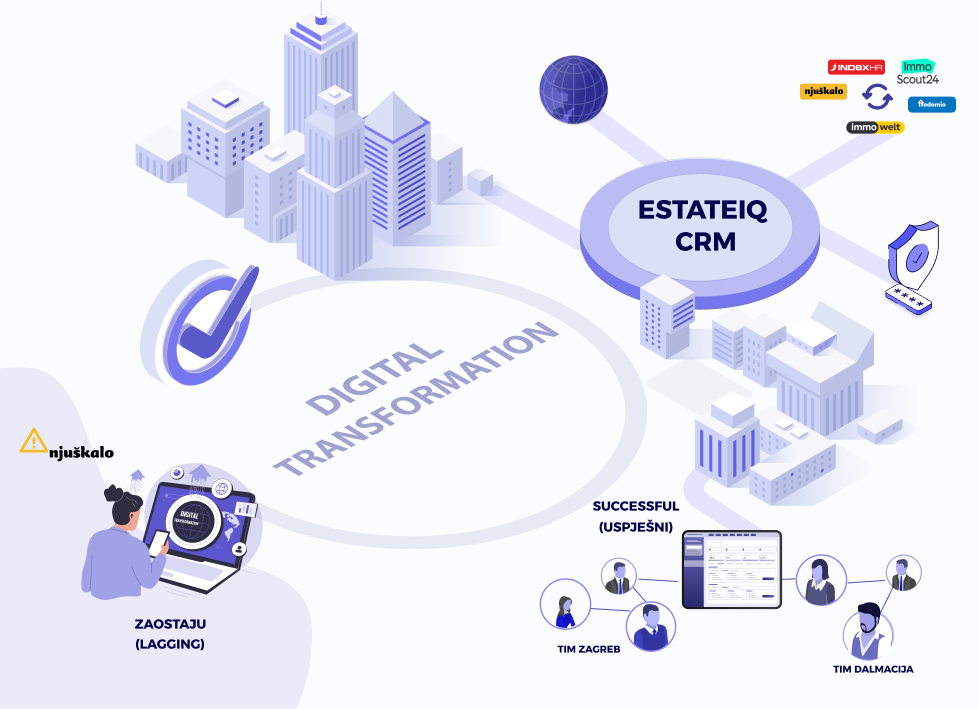
Introduction: a market that does not wait
The Croatian real estate market enters 2026 with clearly changed dynamics. After almost ten years of continuous price growth, the market has entered a phase that experts describe as a “year of selection”: a period in which not everything passes any more, and quality, precision and professionalism win.
The figures confirm it. In the first half of 2025, the Porezna uprava (the Croatian Tax Administration) recorded about 57,000 purchase and sale transactions, a drop of more than 15% compared with the same period of the previous year. At the same time, the average price per square meter of new-build property in Croatia reached €2,754/m², an increase of almost 16% year on year. So the market is not shrinking; it is becoming more demanding. Buyers are more selective, the regulatory framework is more complex and competition among agencies is ever fiercer.
In such an environment, the difference between agencies that grow and those that stagnate increasingly comes down to one question: how far have they digitized their business? Agencies that still rely on Excel spreadsheets, manual entry of listings on portals and paper records simply cannot keep pace with a market that demands speed, accuracy and transparency.
This article analyzes four key digitalization trends shaping the real estate business in 2026, and shows concretely how leading agencies already apply them in practice.
1. Multilingualism as a business imperative, not a luxury
Croatia is a member of the Schengen Area and the eurozone, which has further eased cross-border transactions. Although the share of foreign buyers in the total number of transactions fell in 2025, their influence on the premium segment of the market remains disproportionately large, especially on the Adriatic coast, where German, Austrian and Scandinavian buyers account for the majority of transactions in the luxury segment. At the same time, Slovenia, Italy and the wider DACH region remain key sources of potential buyers for continental and coastal properties.
For agencies this means one thing: if your CRM system cannot generate a property description in German or Italian, if you cannot publish a listing on, for example, ImmoScout24.de from the same interface in which you manage your domestic portfolio, you are losing access to the most valuable clients.
How does EstateIQ solve this?
EstateIQ is built from the ground up for a multilingual market. The complete interface and all property descriptions are available in five languages: Croatian, English, German, Slovenian and Italian. That is not a superficial translation: every property entry has separate language fields for the description, which means your agent can enter a professional description in Croatian for Njuškalo and a localized description in German for ImmoScout24, all within the same form. The result? One property, five markets, zero duplication of work.
2. One system, all portals: from local to international
The average Croatian agency today advertises on three to five portals at the same time. Larger agencies, especially those with international ambitions, use ten or more. Entering the same listing by hand on each portal separately, with different formats, languages and technical requirements, consumes a disproportionate amount of time and produces errors. A wrong price on one portal, an outdated status on another, missing photos on a third: all of this erodes clients’ trust and the agency’s professional reputation.
How does EstateIQ solve this?
EstateIQ integrates more than 20 portals through automated XML feeds, from a single system, with a single click. It is enough to add a property to the “Web” group and it is published automatically on all portals the agency has a contract with.
The range of coverage is impressive. On the domestic market this includes Njuškalo, Index.hr, Crozilla, Oglasnik and RealEstateCroatia. Regionally, the Indomio network covers Croatia, Bosnia and Herzegovina, Montenegro and Greece, while for the wider European market the system enables export to ImmoScout24 (Germany and Austria), Immowelt, Immobiliare.it (Italy), Nepremicnine.net (Slovenia) and JamesEdition for luxury properties at a global level.
When the status of a property changes to “Prodano” (sold) or “Iznajmljeno” (rented), the listing is withdrawn automatically from all portals. No more situations where a sold property “hangs” on Njuškalo for weeks after the deal is closed. That is a level of automation that saves hours of work every week and eliminates reputational risk.
3. Regulatory compliance: from burden to competitive advantage
The regulatory framework for real estate agencies in Croatia is becoming ever more complex. The Zakon o posredovanju u prometu nekretnina (the Croatian Real Estate Brokerage Act) requires detailed records of brokerage activity, and the tax changes that came into force in 2025, including the new property tax, further increase the administrative burden. In addition, new laws on spatial planning, construction and energy efficiency of buildings were adopted at the end of 2025, and their full impact on the market will show in 2026.
Agencies that keep these records by hand, in Word documents, Excel spreadsheets or, worse still, on paper, spend an unnecessary amount of time and expose themselves to the risk of errors and fines. In an era when transparency and professionalism are becoming key differentiators, the ability to produce reports quickly and accurately is not an administrative burden; it is a competitive advantage.
How does EstateIQ solve this?
EstateIQ has an integrated Reports module with a series of specialized submodules that cover the whole range of legal and business obligations. The statutory register of real estate brokerage activity is generated automatically from the data already entered in the system, with no re-entry and no manual formatting.
In addition, the system offers reports on total sales, a log of all business events in the system and marketing analytics. All reports can be exported to CSV or Excel, or sent to print, literally in a few clicks.
4. Teamwork and regional scalability
The real estate market in Croatia has a pronounced regional dimension. The dynamics in Zagreb differ significantly from those in Dalmatia, Istria or on the islands. The average price per square meter in Split exceeds €4,200, in Dubrovnik it goes above €5,000, while in Zagreb it is around €3,100. Agencies that operate in several regions have to follow these differences in real time, not only at the level of an individual property, but at the level of the team, the business unit and the whole organization.
The problem many agencies have is not a lack of data, but the inability to structure and filter it in a way that supports operational decisions. When the agency director cannot see at a glance how many transactions Team Dalmatia closed this month compared with Team Zagreb, or cannot track which agent has the largest portfolio of open orders, management becomes reactive instead of proactive.
How does EstateIQ solve this?
EstateIQ allows organization by business units, for example Team Zagreb and Team Dalmatia, with the option to filter the dashboard by team. The application header contains a drop-down menu for quickly switching between teams, which means a manager can move in a second from an overview of the whole agency to an overview of a specific team.
The system supports defining user roles with granular permissions, which means that agents see only the data relevant to their work, while managers have access to the wider picture. The annual report on the dashboard shows a financial overview and statistics in real time, and every agent has an insight into their own portfolio, open orders and client requirements through the Aplikacija module.
As a cloud-based web application, EstateIQ works in all browsers (Chrome, Firefox, Edge, Safari) without installation. Sign-in is possible with a Google or Microsoft account, which simplifies access for teams that already use those ecosystems. The result is a system that keeps pace with the growth of the agency, from two agents in one office to a multi-regional operation with dozens of employees.
Conclusion: digitalization is not a choice, it is a condition for survival
The real estate market in Croatia is going through a transformation. The number of transactions is falling, buyers are more demanding, the regulatory framework is more complex and competition is more global. In such an environment, agencies that approach their business with yesterday’s tools will not be able to compete with those that use systems built for tomorrow’s challenges.
Digital transformation of the real estate business does not mean merely “having a website” or “using e-mail”. It means having a system that: speaks the languages of your clients, automatically distributes properties to 20+ portals, generates legally required reports without manual work, enables teamwork regardless of location and scales as your agency grows.
EstateIQ is exactly such a system. It was developed in the region, for the region, with a deep understanding of the specifics of the Croatian, Slovenian, Italian and wider European real estate markets.